CosminBadea
I research, lecture, and advise, on AI, decision-making, and ethics, and on value structures we can investigate, implement, and improve.
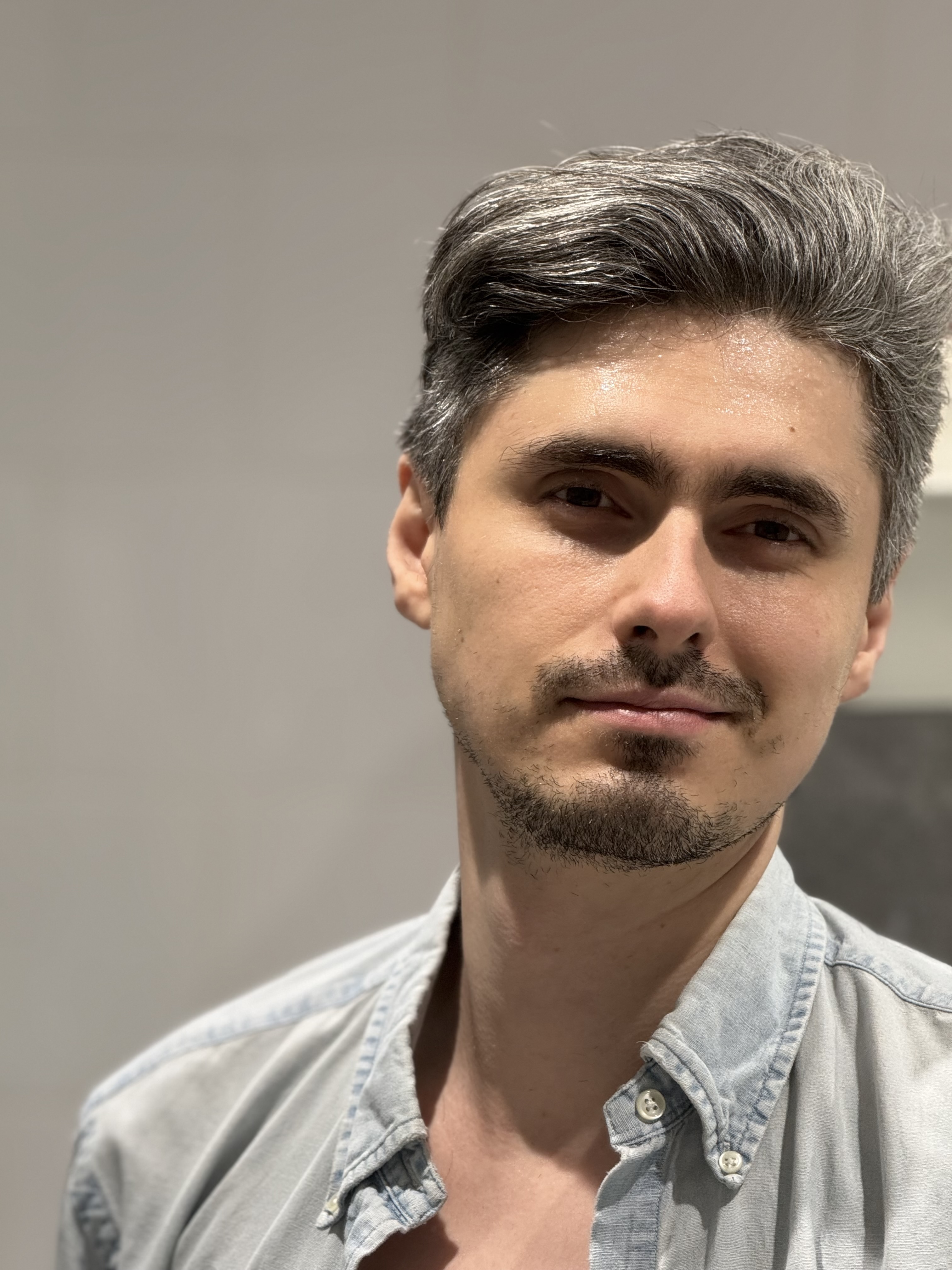
A working note on what I am doing, and why.
My research keeps returning to one problem. We do not yet have good top-down, logic-based, explicitly moral frameworks that a machine can reason through. Read the papers →
Almost everything we currently use is bottom-up. Behaviours shaped by examples, preferences inferred from clicks, refusals trained in by demonstration. That gives us systems whose values we can describe but not interrogate, and whose failure modes are felt before they are understood.
I want to close that gap. The direction I am working in, which I call moral paradigms, is to extract the implicit value structure of a model from its responses to structured probes, in a form that is explicit, logic-based, and inspectable by a human. The paradigm is the artefact; the model behaviour is the evidence; the probes are the instrument.
The bet is simple. If you can write a model's ethics down, you can argue with it.
The shorter version.
I have worked on AI since 2014. I am a lecturer in the Department of Computing at Imperial College London, where I designed and led the department's first AI and Ethics course (2019 to 2023, average student satisfaction 95.45 out of 100), and now design and deliver Contemporary Philosophy and Artificial Intelligence.
My doctoral research at Imperial, supervised by Professor Marek Sergot (Head of the Section of Logic and Artificial Intelligence), is on value-aligned moral agents and rule-based AI. The thesis is complete and awaiting examination. Before that, MEng Computing at Imperial, First Class with Distinction.
I am Chief AI and Ethics Officer on two European Commission consortia, 4P-CAN (€5.3M, personalised oncology, 17 organisations across 11 countries) and FH-EARLY (early diagnosis of familial hypercholesterolaemia, 15 partners across Europe), and the sole AI and ethics lead on several others. In 2024 I founded Ethicos AI, an advisory practice for AI strategy, governance, and responsible deployment in high-stakes settings. I am currently building an Imperial-based research institute on good AI, with a wellbeing focus. Working title, Project Nightingale.
I tend to like work that takes philosophy seriously without losing the ability to ship something a computer can run. Most of the interesting questions live at that join.
Threads I am pulling on.
-
01
Moral paradigms →
Extracting and formalising the implicit value structure of an AI in a way humans can inspect, contest, and improve. The signature line of the work.
-
02
Good decision-making (MARS) →
MARS, the multi-valued action reasoning system, is a general decision-making framework. I happen to apply it to moral reasoning, but the bones are about reasoning over actions, values, and competing considerations in any high-stakes setting.
-
03
Interpretability →
Particularly the question of how much interpretability is enough, for whom, and at what cost. Less a tool, more a contract.
-
04
Value alignment and rule-based AI →
Top-down, logic-first frameworks for machine ethics, including hybrid systems that pair learned components with explicit reasoning. Connected to the Artus and Badea law on scaling and causal power of artificial moral agents.
-
05
Meta-decision-making →
How AI systems choose among decision procedures, and how that choice itself can be made principled and inspectable. An ontology of relevance, representation, and reasoning.
-
06
Philosophy of AI and ethics →
The Wittgensteinian, virtue-theoretic, and rule-following questions that sit underneath what we now call alignment. A serious philosophical reading of what these systems are doing.
-
07
Artificial moral agents →
What it would take, conceptually and computationally, for a machine to count as a moral agent in any non-trivial sense.
-
08
AI ethics in clinical practice →
Concrete settings where the abstract questions bite. Antimicrobial decision-making, personalised oncology, breaking bad news, and AI in mental health and wellbeing.
Some papers I am happy to talk about.
-
012022
-
022022
-
032022
-
042025
-
052021
-
062023
-
072022
-
082022
Full list, with preprints, on Google Scholar. Or read the papers here →
- Citations
- 141 Total number of times other papers have cited mine. A coarse measure of how widely the work has been read and used.
- h-index
- 8 The largest h such that I have h papers each cited at least h times. Rewards consistent impact over a one-off hit.
- i10-index
- 7 Number of my papers with at least 10 citations each. Google Scholar's measure of how many of my papers have crossed a baseline of community uptake.
- As of
- May 2026 Updated by hand. AI safety and ethics is a smaller, slower-citing field than ML proper, where individuals routinely see thousands. Sadness :(
In the lecture theatre.
-
2021–Contemporary Philosophy and Artificial Intelligence. A cross-disciplinary course covering analytic philosophy (meaning, free will, philosophy of language, logic), continental philosophy and phenomenology, ethics, AI, decision-making, and AI ethics. For third- and fourth-year STEM undergraduates.Permanent Lecturer . Imperial College London
-
2019–2023AI and Ethics. Designed and led the Department of Computing's first course on the subject, for MSc AI and PhD students. Topics included rule- and logic-based ethics, interpretability, fairness, and moral agent construction. Average satisfaction 95.45 / 100; audience expanded to multiple UKRI Centres for Doctoral Training.Course Leader & Lecturer . Imperial College London
-
OngoingProject supervisions translating AI concepts into implemented systems and peer-reviewed papers.Imperial . external
Where I sit.
-
2021–Lecturer. Department of Computing, Imperial College London.London
-
2024–Founder and Managing Director. Ethicos AI Ltd. Advisory, coaching (technical, executive, leadership, and strategy), and tutoring on AI, ethics, and responsible deployment in high-stakes settings. Audiences from school-age learners to chief executives.London
-
2023–Chief AI and Ethics Officer. 4P-CAN, a €5.3M EC-funded consortium on cancer prevention, with 17 organisations across 11 EU, Western EU, and Balkan countries. Interpretability standards, data governance, and responsible deployment.European Commission, INOMED
-
2023–Chief AI and Ethics Officer. FH-EARLY, an EC-funded initiative on the early diagnosis of familial hypercholesterolaemia, with 15 partners across Europe and beyond. AI and ethics strategy, cross-partner delivery, model validation, and publication roadmap.European Commission, INOMED
-
OngoingEthics and data protection lead across CURTAIN, EU-CIP, CAREWAY, and CONSENSUS consortia.European Commission, INOMED
-
2021–Lead Research Fellow. World Ethical Data Forum.
-
OngoingReviewer. AI and Ethics (Springer), Frontiers in Health Services. Steering Committee, AAAI Fall Symposium (COGSAT). Member, Imperial-X (Human-AI).
A selection from the past year.
-
May 2026A dedicated research page goes up: read the papers, share a thought, explore at your own pace.
-
May 2026Ethicos AI launches its public site soon at ethicos.co.uk.
-
May 2026New site, new direction. The work has a name: moral paradigms.
-
Feb 2026Took on AI and ethics roles across CURTAIN, EU-CIP, CAREWAY, and CONSENSUS through INOMED.
-
Oct 2025Advised for Draftix AI on AI research and strategy.
-
Sep 2025Paper with Vijayaraghavan on minimum interpretability published in AI and Ethics.
-
Dec 2024Founded Ethicos AI Ltd.
Nothing new to report just now. The work is quieter than the website.
Off the page, in another voice.
Away from the work, I read (especially science fiction and philosophical texts), debate ideas with anyone who will, listen to a great deal of music, and take a good story however it arrives, in a book, a game, or a friend's telling. I fence, play football, and walk my Samoyed, Icy, who is unimpressed by all of the above.
I sometimes write poetry. It tends to be quieter, slower, and sadder than the rest of the page. A small reading, behind a closed door →
Reach out.
I read everything. I am especially interested in conversations with people working on alignment evaluation, interpretability for moral content, and the awkward spaces between philosophy and engineering. I also advise, coach, and tutor, on AI and ethics, for audiences from school-age learners to chief executives. Slow replies are not silence.